One of the most overlooked but high-impact strategies is consistently replying to user reviews. Responding to app reviews has a direct and measurable effect on App Store Optimization (ASO).
This article explains exactly how review replies work for your ASO in 2025.
How responding to reviews impacts app ranking
1. Developer engagement signal
Both Google Play and the App Store use developer activity — especially review replies — as a trust signal in their algorithms. When you respond regularly, your app is seen as actively maintained and user-focused.
2. Influence on average rating
Thoughtful and timely responses, especially to negative reviews, significantly increase the chances that users will update their low ratings (e.g., from 1★ to 4-5★). This directly boosts your app's average rating.
- Higher search rankings
- Better conversion from views to installs
- More organic downloads

Screenshot from Google Play Console showing rating updates for Don't Touch app →
Google Play Console tracks rating updates — you can see exactly how many users changed their ratings after your responses.
Learn more in Google Play's official documentation →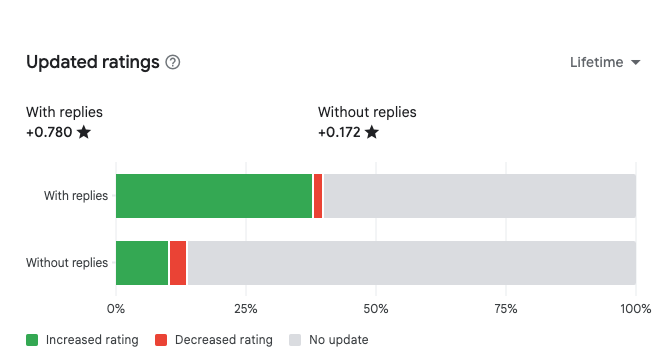
Another example from How to Draw Anime app →
3. Indexing of replies and keywords (Google Play only)
Google Play indexes your review replies. Adding natural, context-relevant keywords ("bug fix", "feature request", "security update") into your responses provides additional semantic context for the Play Store's ranking algorithms.
Note: This does NOT apply to the App Store, where review replies are not indexed. For Google Play, this is a proven and recommended ASO tactic.
4. Speed and satisfaction
The faster and more constructively you reply to a review, the more likely you are to resolve user issues. Modern algorithms detect "review improvement speed" and upward shifts in user sentiment as strong quality signals.
5. Review volume and recency
Replying stimulates users to leave additional feedback, knowing someone is listening. This tends to generate a higher volume of fresh reviews. App store algorithms heavily weight recent engagement and fresh feedback.
6. Conversion uplift
Potential users browse both ratings and developer responses before downloading. Public, helpful responses significantly increase install conversion rates.
Summary: Why review replies matter
In practice: Apps that regularly reply to reviews see:
- Higher average ratings
- Improved install conversion rates
- Greater review freshness and volume
- Higher rankings in searches and categories
- Increased chances to get featured by the store
2025 Developer checklist
1. Reply regularly
Set up Play Console notifications for new reviews. Aim to answer within 24 hours, especially for 1-2★ feedback.
2. Prioritize feedback
Respond first to 1-2★, bug reports, and support requests. Then follow up on neutral/positive reviews.
3. Be polite and professional
Use an empathetic, helpful tone. Thank users for feedback, even if it's negative.
4. Address issues publicly
Acknowledge the problem, say what will happen ("We're fixing this in the next update"). Invite further contact via email if needed.
5. Use keywords smartly (Google Play only)
Naturally include key app features ("offline mode", "new dashboard", "sync error fixed"). Never keyword-stuff.
6. Appreciate positive reviews
Always thank users for positive feedback. Encourage sharing with friends.
7. Respond to review updates
If a user updates their review, reply again — say thanks for returning!
8. Track trends and issues
Look for recurring topics ("30% of negative reviews mention Facebook login issues"). Prioritize fixes based on patterns.
9. Handle unfair reviews professionally
Never accuse users — politely request additional details. Report if the review is clearly spam.
10. Remember: Everything is public
Every response is visible — it builds your long-term reputation. Make sure only trained team members reply.
Quick response templates
Negative review:
"Thank you for reporting this issue. We apologize for the inconvenience — our team is working on a fix and we aim to solve this in the upcoming update. For more details, feel free to reach us at [support email]."
Positive review:
"Thank you for the positive feedback! We're glad our app meets your needs. Feel free to recommend it to your friends :)"
After a review update:
"Fantastic, glad it's resolved! Thank you for coming back and updating your review. Every piece of feedback matters to us."
The bottom line
Regularly replying to user reviews is no longer optional in 2025 — it's a core ASO habit with measurable impact on ranking, installs, and reputation for your app.